Computational Reaction Dynamics



In our laboratory, we study how the molecular environment can catalyze chemical reactions and promote the binding of specific molecules and metals. Using molecular dynamics simulations with well-parameterized force fields and electronic structure methods, we investigate chemical reactions and interactions in enzymes, liquids, and interfaces.
Carbon dioxide is one of the most abundant greenhouse gases and a major driver of global warming. At the same time, photosynthesis shows us a powerful natural solution: converting CO2 into biomass and sustaining life on Earth.
Our laboratory studies how enzymes capture carbon dioxide and convert it into valuable organic compounds. We focus on the mechanisms of RuBisCO and highly efficient CO2-fixing enzymes to understand CO2 binding, coupled protein conformational and protonation changes, and product formation.
To address the CO2 distribution in enzymes and the associated conformational changes, we work in close collaboration with Prof. Grubmüller at the Max Planck Institute Göttingen in Germany through the established Computational Reaction Dynamics Max Planck Partner Group.
Through close collaboration with Prof. Grubmüller at the Max Planck Institute Göttingen and Prof. Erb at the Max Planck Institute Marburg, we combine computation, biochemical characterization, and kinetics to build a detailed picture of these molecular machines.
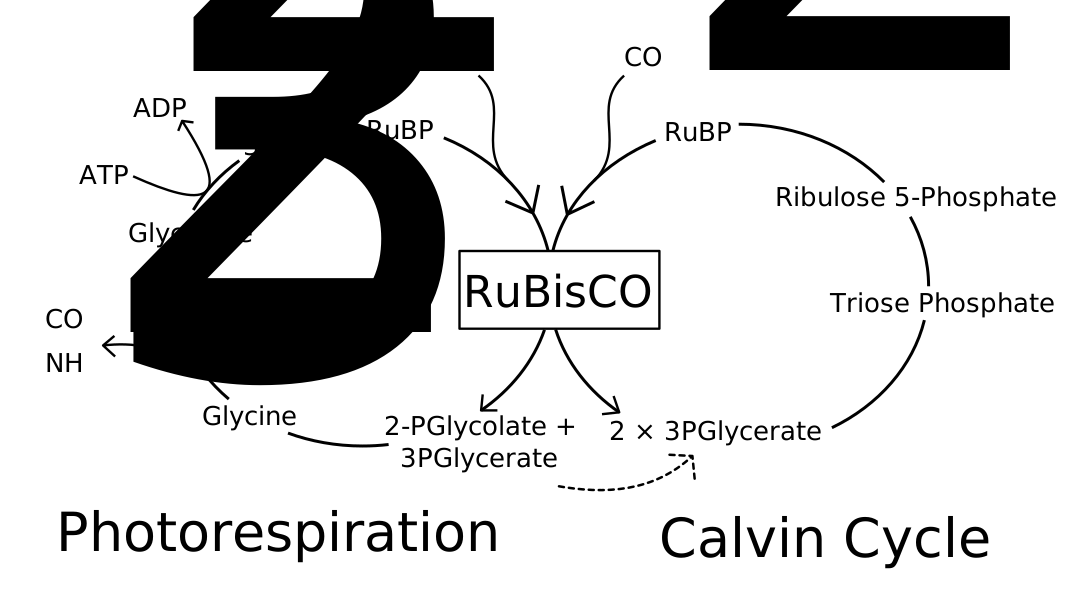

Carbon dioxide is one of the most abundant greenhouse gases associated with global warming. One of the main goals to reduce global warming’s adversary effects is to reduce its emission and develop alternative methods to transform this gas into valuable compounds.
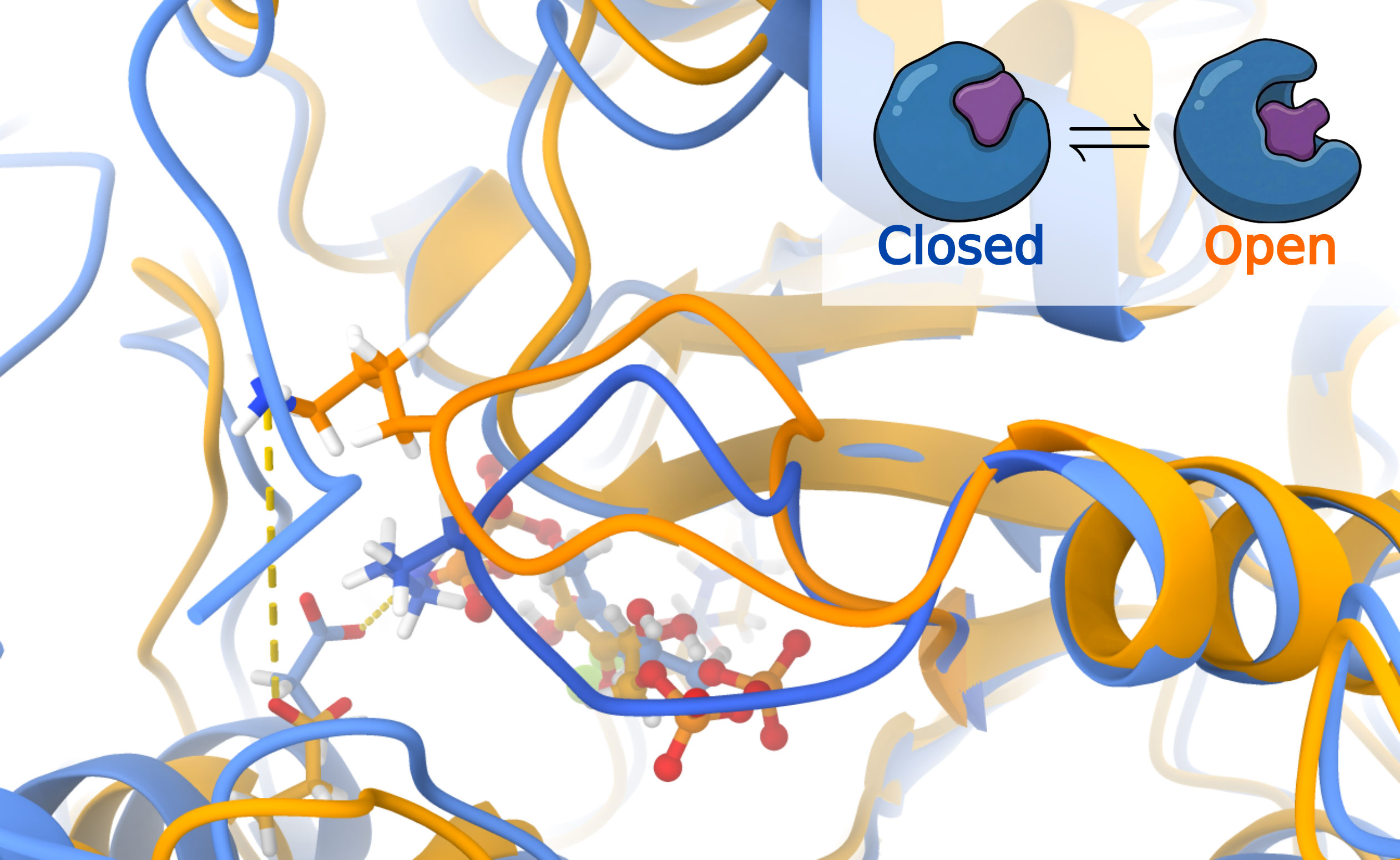
In our lab we try to understand how enzymes fix CO2 and transform it to organic compounds with high efficiency. We have studied the reaction mechanism of RuBisCO, one of the most abundant proteins that fixes most of atmospheric CO2 in the Calvin cycle. Although abundant, RuBisCO is not the most efficient one. To learn from the best in Nature, we focused on the family of Enoyl-crotonyl-CoA carboxylase/reductase, which possess the fastest fixation rate observed in enzymes and no side reaction with oxygen. At the end, we would like to disclose the whole catalytic cycle: possible conformational changes of the protein in the catalytic cycle, CO2 binding in the active site and the reaction mechanism to form the products.
To address the CO2 distribution in enzymes and the associated conformational changes, we work in close collaboration with Prof. Grubmüller at the Max-Planck Institute Göttingen in Germany in the established Computational Reaction Dynamics Max-Planck Partner group.
The reaction mechanism is elucidated from a computational point of view by us. Our results, together with the biochemical characterization of the protein structure with Prof. Soichi at Stanford and the kinetics in the group of Prof. Erb at the Max-Planck Institute Marburg, provide a detailed picture of how these molecular machines are able to transform CO2 efficiently.
Our final goal is to understand how these enzymes work and then design new variants with enhanced efficiency to be applied in biocatalysis.
| Year | Publication | Journal | Links |
|---|---|---|---|
| 2026 | D-MBIS Nonbonded Force Field Parameters Improve Specificity and Selectivity Prediction in Bromodomains | J Phys Chem B | |
| 2026 | Electric fields enhance Diels-Alderase catalysis in abyssomicin C biosynthesis | Chem Commun (Camb) | |
| 2025 | Adapted DFTB3 Repulsive Potentials Reach DFT Accuracy for Hydride Transfer Reactions in Enzymes | J Comput Chem | |
| 2025 | Fast rational enzyme design by computational non-equilibrium alchemical transformations | Chem Commun (Camb) | |
| 2025 | Multiobjective Evolutionary Strategy for Improving Semiempirical Hamiltonians in the Study of Enzymatic Reactions at the QM/MM Level of Theory | J Chem Theory Comput | |
| 2025 | Nonbonded Force Field Parameters Derived from Atoms-in-Molecules Methods Reproduce Interactions in Proteins from First-Principles | J Chem Theory Comput | |
| 2024 | Computational methods for the study of carboxylases: The case of crotonyl-CoA carboxylase/reductase | Methods Enzymol | |
| 2024 | GBasis: A Python library for evaluating functions, functionals, and integrals expressed with Gaussian basis functions | J Chem Phys | |
| 2024 | Grid: A Python library for molecular integration, interpolation, differentiation, and more | J Chem Phys | |
| 2024 | Infrared spectroscopy reveals metal-independent carbonic anhydrase activity in crotonyl-CoA carboxylase/reductase | Chem Sci |
1–10 of 55


Computational Reaction Dynamics

QM/MM simulations of RuBisCO oxygenation and electronic-state crossings
Protein conformational changes through enhanced-sampling molecular dynamics

Enzymatic fixation of CO2 by multiscale methods

RuBisCO active-site protonation through constant-pH molecular dynamics

Calculations of free energy using alchemical transformations and non-equilibrium methods

Hydration entropy calculation through Per|Mut and thermodynamic integration methodologies

Constant pH Molecular Dynamics Simulations

Conformational dynamics of bacterial Form II RuBisCO variants

Constant pH simulations
To Update
To Update